Wenzhou’s factories are going smart: what we saw on 10 September 2026, and what it means for buyers
Wenzhou’s eyewear, lock, footwear, auto-parts and electrical makers are selling connected and AI products, and on 10 September 2026 we walked the exhibition where many of them showed their new lines. The products are real. So is the gap between a factory that knows the mechanical version and a supplier that can stand behind the electronics, the firmware and the certificates that come with them.
Direct answer: the innovation exhibition held with the 2026 Private Economy Innovation and Development Conference in Wenzhou showed more than 120 companies, nearly 70% of them from Wenzhou, according to the Wenzhou Evening News. Many were established makers in the city’s traditional industries, now showing AI glasses, electronic door locks, footwear with electronics and robotics. For a buyer, the connected version of a familiar product needs different certificates and a different supplier check: radio, cybersecurity and software-support obligations apply that the mechanical version never carried.
The exhibition, briefly
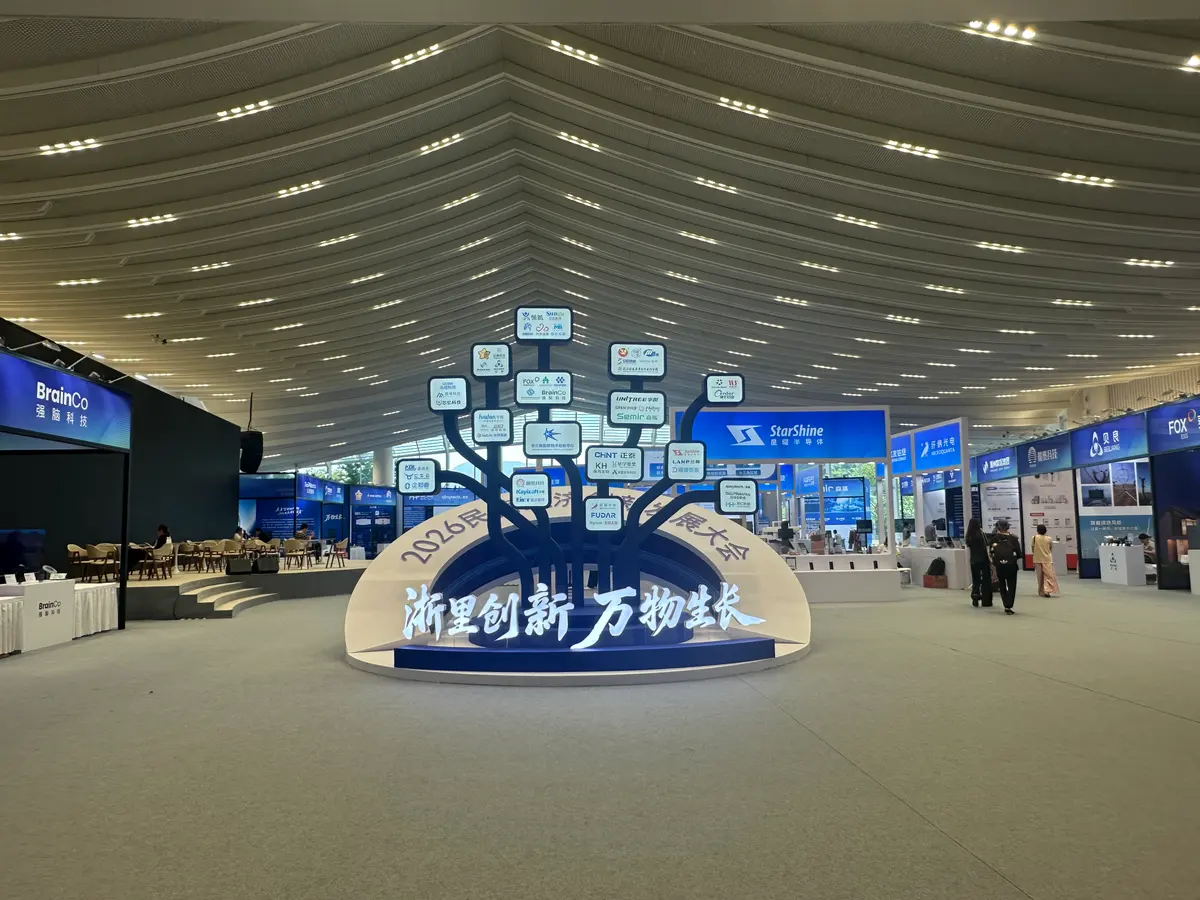
The 2026 Private Economy Innovation and Development Conference was held in Wenzhou on 8 and 9 September, hosted by the All-China Federation of Industry and Commerce and the Zhejiang Provincial Government, with more than 600 invited guests. Its main session took place on 9 September at the International Conference Centre in Wenzhou Garden Expo Park, and an exhibition of companies’ new products, titled 浙里创新 万物生长, opened in the park’s China Pavilion the same day.
The Wenzhou Evening News counted more than 120 exhibitors across three areas (new energy and new materials, artificial intelligence, and life sciences), nearly 70% of them Wenzhou companies. We walked the exhibition on 10 September. The photographs on this page are ours.
What the traditional clusters showed
Eyewear: AI glasses
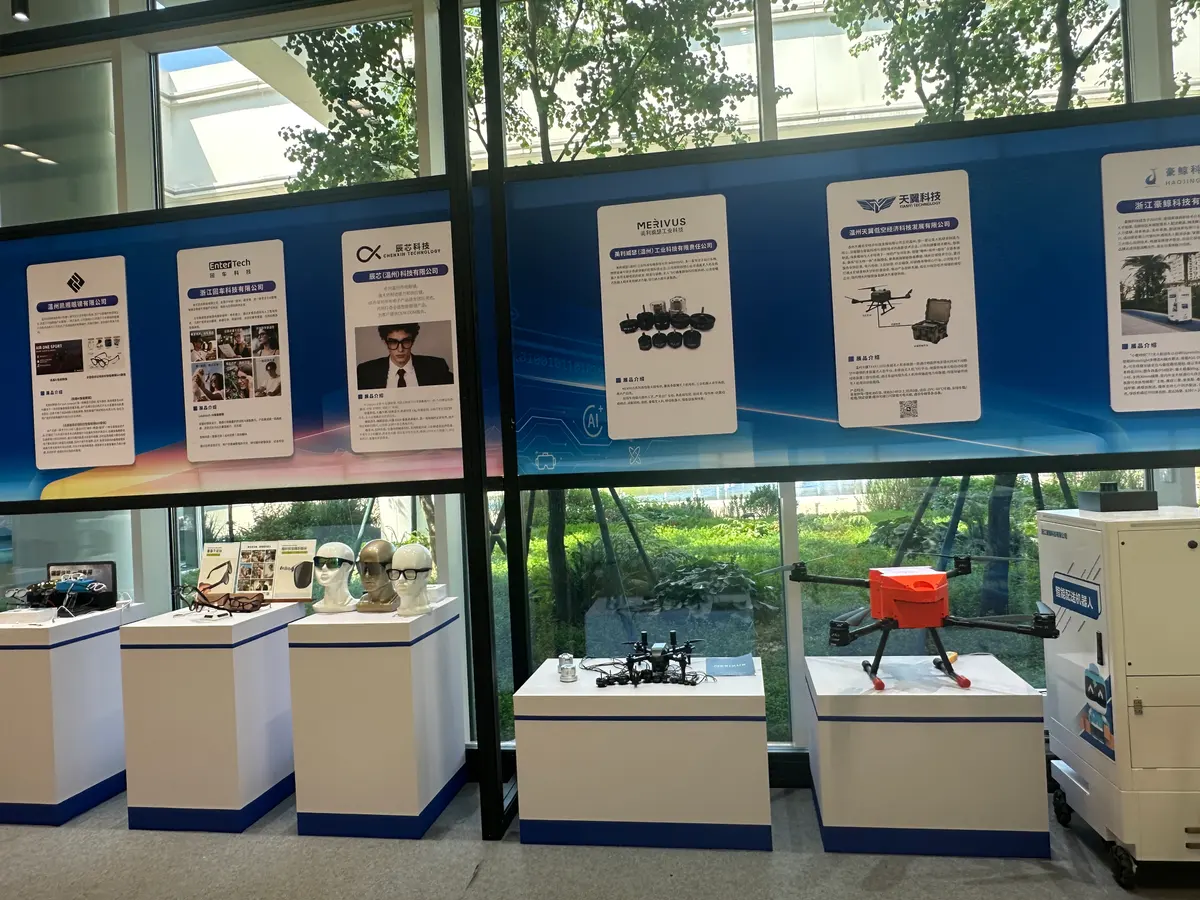
Wenzhou eyewear companies had a row of AI glasses on show. According to the Wenzhou Evening News, 温州凯顺眼镜 (Wenzhou Kaishun Eyewear) presented glasses for children that remind the wearer about posture and reading distance, weigh a little over 30 grams and retail for around 1,000 yuan. 浙江回车科技 (EnterTech) showed AI glasses with object recognition, menu translation and an AI assistant, and the paper reported that it reached volume production quickly by drawing on the eyewear supply chain in Ouhai. A third exhibitor, 辰芯(温州)科技 (Chenxin Technology), said on its panel that it builds on Wenzhou’s eyewear industry and offers OEM and ODM production.
Locks and footwear: electronics inside
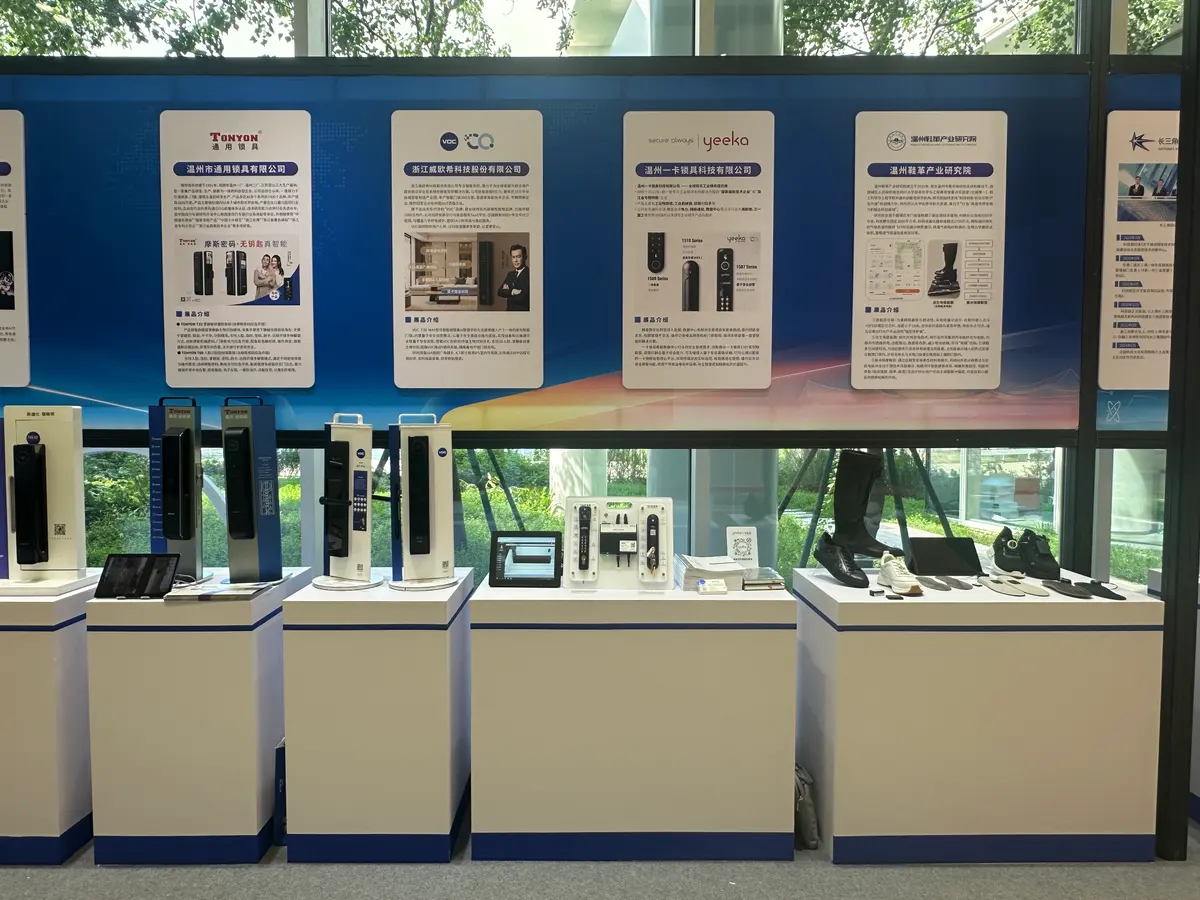
Next to them, three lock makers, 温州市通用锁具 (TONYON), 温州一卡锁具科技 (yeeka) and 浙江威欧希科技 (VOC), showed electronic door locks, several with keypads. On the next plinth, the Wenzhou Shoe and Leather Industry Research Institute (温州鞋革产业研究院) displayed shoes and insoles fitted with small electronic modules.
Auto parts: a robotic arm from a chassis-parts maker
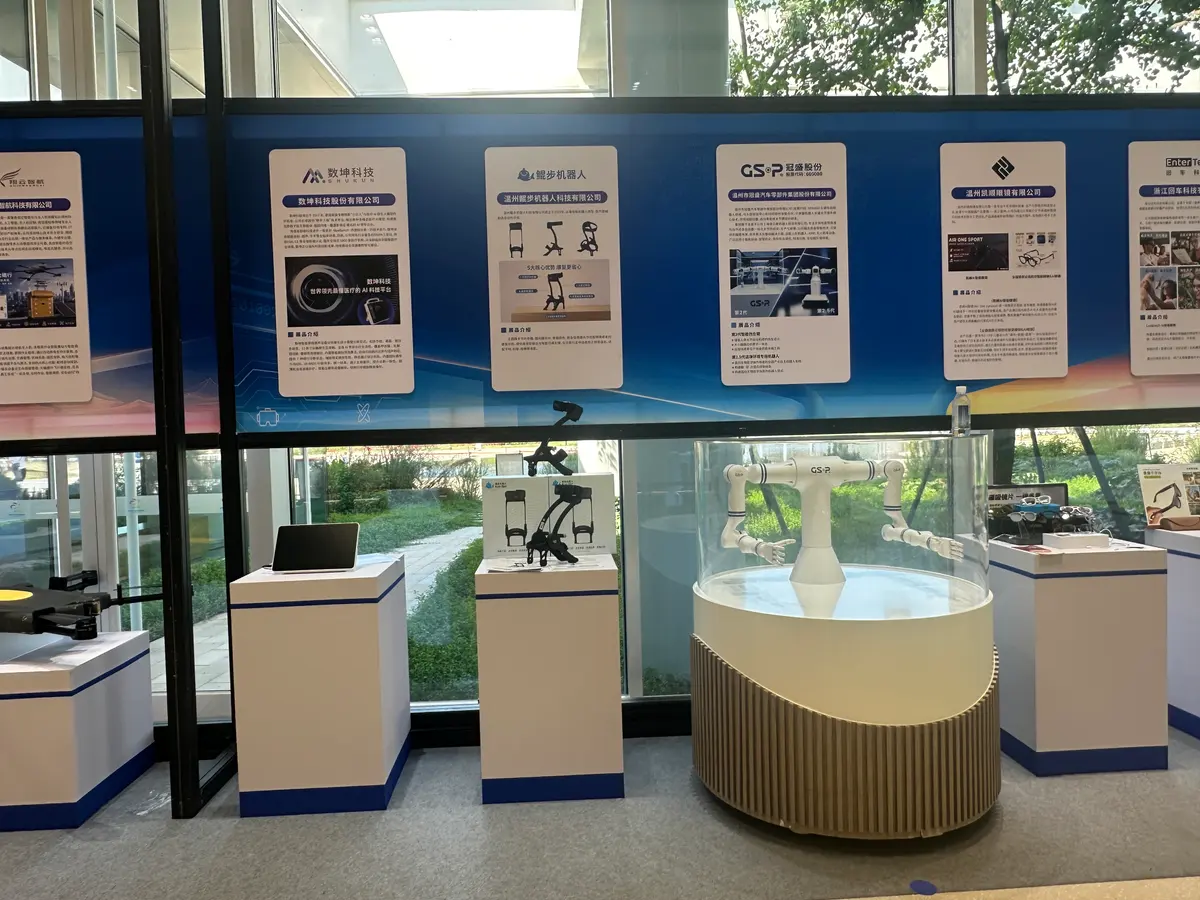
GSP (冠盛股份), which the Wenzhou Evening News describes as a maker of vehicle chassis parts for several decades, showed a humanoid robotic arm whose joints, the company said, draw on its universal-joint technology. Beside it, 温州鲲步机器人 (Wenzhou Kunbu Robotics), founded in June 2025 by the second generation of an auto-parts family, showed an unpowered ankle exoskeleton. The paper reported that it weighs 380 grams and sold nearly 500 units in a little over a month on sale.
Electrical: materials and energy equipment
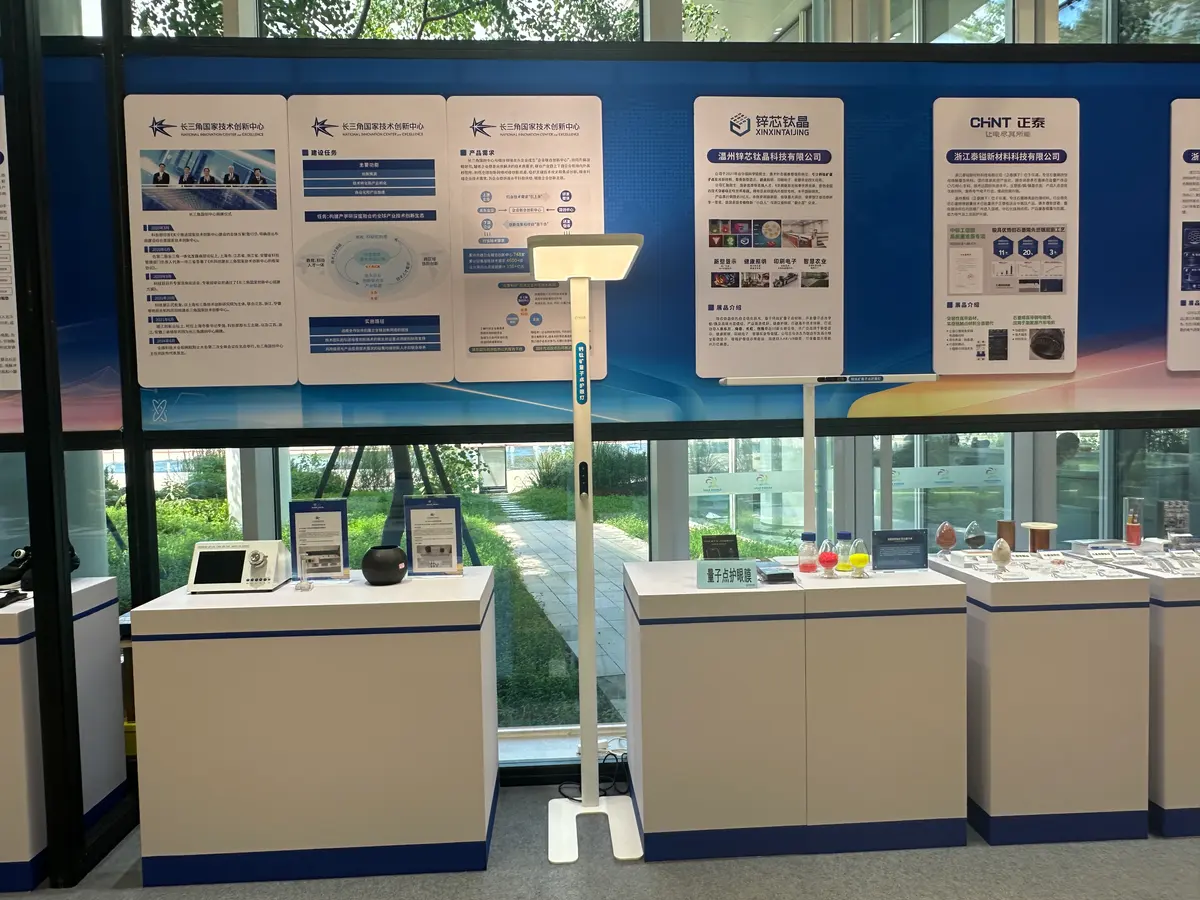
CHINT (正泰), the Yueqing electrical group, showed work from its new-materials company, including graphene high-conductivity copper winding wire for electric-vehicle motors. The newspaper also named electrical-contact materials from FUDAR (福达合金) among the new-materials exhibits.
The plan behind it
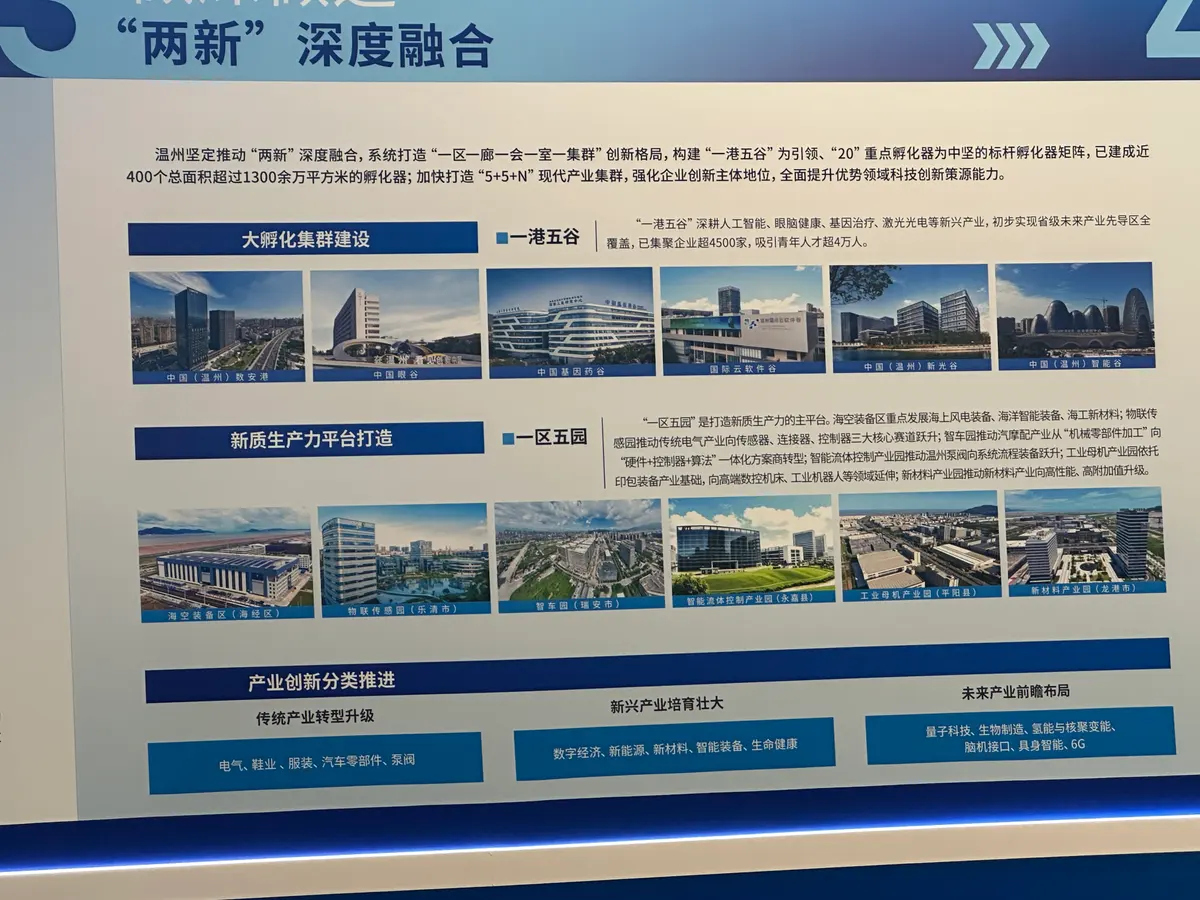
One of the exhibition’s own panels set out Wenzhou’s industrial plan. It lists the city’s traditional industries for upgrading as electrical equipment, footwear, garments, auto parts, and pumps and valves, which are the clusters our industry pages cover. It describes a Yueqing park moving the traditional electrical industry toward sensors, connectors and controllers; a Ruian park moving auto and motorcycle parts from machining components toward integrated hardware, controllers and algorithms; and a Yongjia park moving Wenzhou’s pumps and valves toward complete flow-system equipment.
Those are policy aims rather than measurements. They do match what was on the stands.
What changes for a buyer
This section is our reading, from doing supplier checks in these clusters. The exhibition did not say it.
1. The track record belongs to the old product
A lock maker’s years of cylinders, or an eyewear maker’s years of frames, tell you about metalwork, plating and fit. They tell you nothing about firmware, radio modules or the app a customer will depend on. Those parts are often designed or made by another company, and an ODM offer on a glasses maker’s panel is a reminder that several brands can share one source. Ask which companies design and make the electronics, the firmware and the app, and check those entities, not only the one on the quotation. See is my supplier a factory or a trading company?
2. The mechanical certificates do not cover the electronics
A connected product is radio equipment first, whatever it looks like.
- EU. Radio products fall under the Radio Equipment Directive. Since August 2025, its requirements on cybersecurity, personal data protection and privacy have applied to certain categories of radio equipment, such as internet-connected devices. The Commission has already published their repeal with effect from 11 December 2027, when the main obligations of the Cyber Resilience Act apply. The Act’s reporting obligations for manufacturers have applied since 11 September 2026.
- UK. Since 29 April 2024, consumer connectable products must have passwords that are unique to each product or set by the user, and the manufacturer must publish how to report security issues and a minimum period for security updates.
- US. Radio-frequency devices must be authorised by the FCC before they are marketed or imported. The FCC ID on the label can be looked up in the FCC’s own database.
- AI features. Where a product talks to people or generates content, the EU AI Act’s transparency duties may apply. See the EU AI Act and Chinese-made products.
3. Software has a lifetime the purchase order does not show
A lock that stops receiving updates, or an app whose servers are switched off, is a product problem you own after delivery. Before you order, get in writing who runs the app and its servers, where user data is stored, and how long security updates will be provided. UK law already requires that last figure to be published, and the Cyber Resilience Act brings security-update duties to products sold in the EU from December 2027.
4. A stand is marketing
“First in China”, first-month sales and battery life are what an exhibitor says about itself. Treat them as claims until a test report names your model and the certificate checks out with the body that issued it. That is what our certificate verification does.
What we are not claiming
The companies named on this page were exhibitors. We have no commercial relationship with any of them, we have not verified them, and naming a company here is not a recommendation. Product descriptions and figures are the exhibitors’ own, as reported by the Wenzhou Evening News or shown on their panels. The regulatory summary is orientation for buyers, not a view on whether any particular product complies.
Where we are. Wenzhou Garden Expo Park is in Ouhai, the district of Wenzhou that carries the city’s eyewear and lock industries. Our office is in neighbouring Lucheng, which is how we could walk the exhibition on a Thursday morning.
Quick FAQ
What was shown at the September 2026 innovation exhibition in Wenzhou?
The exhibition held with the 2026 Private Economy Innovation and Development Conference opened on 9 September 2026 in the China Pavilion at Wenzhou Garden Expo Park. The Wenzhou Evening News reported more than 120 exhibitors, nearly 70% of them Wenzhou companies, across new energy and new materials, artificial intelligence, and life sciences. Established Wenzhou makers showed AI glasses, electronic door locks, footwear with electronics and robotics.
Do smart locks and AI glasses need different certification from the ordinary versions?
Usually, yes, because a connected product is radio equipment. In the EU it falls under the Radio Equipment Directive, whose cybersecurity requirements have applied since August 2025 and are due to be replaced by the Cyber Resilience Act from 11 December 2027. In the UK, consumer connectable products have had to meet security requirements since 29 April 2024. In the US, radio-frequency devices must be authorised by the FCC before they are marketed or imported. Certificates for the mechanical version cover none of this.
How do I check who actually makes the electronics in a Chinese smart product?
Ask the supplier in writing which companies design and make the electronic module, the firmware and the app, then look each one up on China’s national enterprise registry and read its registered business scope. Check certificate numbers with the bodies that issued them, look up the FCC ID in the FCC’s own database if the product is sold in the US, and make sure every test report names your model.
Send someone to the next one
We attend fairs and exhibitions on your brief, film the stands that matter, collect specifications and prices, and gather each exhibitor’s registered identity so it can be checked before you commit. Fee-only, paid by you.
Sources
- Chao News (潮新闻), republished by Wenzhou Garden Expo: the 2026 Private Economy Innovation and Development Conference, its hosts, dates and programme, 8 September 2026 (retrieved 14 September 2026)
- Wenzhou Evening News (温州晚报), republished by Wenzhou Garden Expo: exhibitor count, share of Wenzhou companies and the products described, 10 September 2026 (retrieved 14 September 2026)
- European Commission: Radio Equipment Directive, cybersecurity delegated regulation in application since August 2025 and its repeal effective 11 December 2027 (retrieved 14 September 2026)
- European Commission: Cyber Resilience Act, reporting obligations from 11 September 2026 and main obligations from 11 December 2027 (retrieved 14 September 2026)
- UK Government: the product security regime for consumer connectable products, in effect since 29 April 2024 (retrieved 14 September 2026)
- US Federal Communications Commission: equipment authorisation of radio-frequency devices before marketing or import (retrieved 14 September 2026)
- US Federal Communications Commission: FCC ID search
This guide is general information, not legal advice. Requirements vary by city, document and personal circumstances. Confirm your specific case before acting. Last checked 14 September 2026.